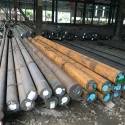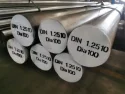
O1 | 9CrWMn | 1 .2510 | 9XBГ
- O1 tool steel is a low alloy cold work tool steel that must be oil-quenched in heat treatment. Tools and dies made from O1 tool steel flat or rounds will have good wearing and abrasive qualities since the tungsten and higher chromium content gives improved wear resistance.
- It has deep hardening properties with fine grain structure with unusual toughness. AISI O1 tool steel offers good durability, gives excellent wear resistance and holds a good cutting edge. O1 cold work tool steels also has good response to heat treatment with small dimensional changes.
Description
Chemical Composition
| Standard | Grade | C | Mn | P | S | Si | Cr | V | W |
| ASTM | O1 | 0.85- 1.00 | 1.00- 1.40 | ≤0.030 | ≤0.030 | 0. 10-0.50 | 0.40-0.60 | ≤0.30 | 0.40-0.60 |
| DIN | 1.251 | 0.90- 1.05 | 1.00- 1.20 | ≤0.030 | ≤0.030 | 0. 15-0.35 | 0.50-0.70 | 0.05-0. 15 | 0.50-0.70 |
| JIS | SKS3 | 0.90- 1.00 | 0.90- 1.20 | ≤0.030 | ≤0.030 | ≤0.35 | 0.50- 1.00 | 0.50- 1.00 | |
| GB | 9CrWMn | 0.85-0.95 | 0.90- 1.20 | ≤0.030 | ≤0.030 | ≤0.40 | 0.50-0.80 | 0.50-0.80 |
Supply Range
Surface Finish: Black, Peeled, Machined/Turned or as per given requirements.
Forged Round Bar: 20mm - 650mm (Dia)
Rolled Bars: 12mm - 360mm (Dia)
Forged flats: 30-400mm(T)*500-1200mm(W)
Rolled flats: 10-360mm(T)*30-1020mm(W)
Other sizes of O1 material or as per customer’s requirements
Heat Treatment
Forging
Heat slowly and begin forging at 980~1000 degrees centigrade. Do not allow temperature to fall below 800 degrees centigrade re-heating if necessary. Annealing will be necessary after forging.
Annealing
All of our Ground Flat Stock and Gauge plate is supplied in the annealed machinable condition. Re-annealing will only be necessary it the steel has been forged by the tool maker. To anneal, heat slowly and uniformly in a closed box or tube to 740~760 degrees centigrade. Maintain at the temperature and allow to cool with the furnace until the temperature falls below 500 degrees centigrade. Withdraw from box or tube and allow to cool in air to shop temperature. Annealed hardness will be in the region of 229 Brinell.
Stress Relieving
When tool are heavily machined, ground or subjected to cold work, the relief of the internal strains is essential before hardening. Stress relieving should be done after rough machining. To stress relieve, heat carefully to 670~700 degrees centigrade. Soak well and to cool in air. The tool may then be finish machined before hardening.
Hardening
Heat slowly and if possible pre-heat at 300~500 degrees centigrade before raising to the hardening temperature of 780~820 degrees centigrade. Pre-heating is especially desirable for complex sections. Soak thoroughly, allowing 30 minutes per inch of ruling section before quenching. Light sections should be quenched in oil from the lower end of the hardening range. Long slender sections should always be suspended in the furnace for heating and quenched by plunging vertically into the oil bath. Tempering is always needed after hardening.
Tempering
Temper between 150 and 350 degrees centigrade according to the requirements of the job and by reference to the tempering curve. Soak for one hour at the tempering temperature. Where possible, use an air-circulating furnace.
Applications
O1 steels are mainly used for short run tooling for cold forming dies, blanking dies, and cutting tools operating at ambient temperature.
Typical applications for O1 tool steel are blanking, forming, and trim dies, gages, slitting cutters, punches, bolster dies, knock-out pins, thread roll dies, bending dies, plastic mold dies, shims, cams, machine ways, stamps, machine parts, jigs, cutter templates, swaging dies, etc.