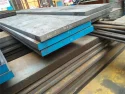
ASTM H10 | 1.2365 | 32CrMoV12-28 | SKD7
- 1.2365 H10 The AISI classifies chromium hot work tool steel as group H steels, ranging from H1 to H19. H10 Chromium hot work tool steel has excellent resistance to softening at high temperatures. This particular grade is resisitant to thermal fatigue cracking and can be cooled in water for servicing.
- H10 Tool Steel is capable of being heat treated to higher hardness than the tungsten hot work steels, and in addition offers greater toughness. H10 tool steel has good thermal fatigue characteristics, and unlike the tungsten hot work steels and H10 hot work tool steels may be safely water cooled in service.
Description
AISI H10 Steel Grade
| Country | USA | German | Japan |
| Grades | H10/T20810 | 1.2365/32CrMoV12-28 | SKD7 |
H10 Tool Steel Chemical Composition(%)
| Steel Grade | C | Si | Mn | P | S | Cr | Mo | V |
| H10/T20810 | 0.35/0.45 | 0.80/1.25 | 0.20/0.70 | ≤0.030 | ≤0.030 | 3.00/3.75 | 2.00/3.00 | 0.25/0.75 |
| 1.2365/32CrMoV12-28 | 0.28/0.35 | 0.10/0.40 | ≤0.030 | ≤0.020 | ≤0.025 | 2.70/3.20 | 2.60/3.00 | 0.40/0.70 |
| SKD7 | 0.28/0.35 | 0.10/0.40 | 0.15/0.45 | ≤0.030 | ≤0.030 | 2.70/3.20 | 2.50/3.00 | 0.40/0.70 |
Supply Range
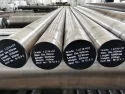
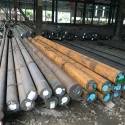
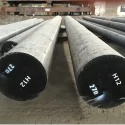
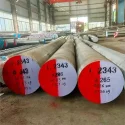
Surface Finish: Black, Peeled, Machined/Turned or as per given requirements.
Forged Round Bar: 20mm - 650mm (Dia)
Rolled Bars: 12mm - 360mm (Dia)
Forged flats: 30-400mm(T)*500-1200mm(W)
Rolled flats: 10-360mm(T)*30-1020mm(W)
Other sizes of O1 material or as per customer’s requirements.
AISI H10 Tool Steel Heat Treatment
FORGING: Heating for forging must be done slowly and uniformly. Soak through at 1900-2000°F, and reheat as often as necessary, stopping work when the temperature drops below 1650°F. After forging cool slowly in lime, mica, dry ashes or furnace. H10 hot work tool steel should always be annealed after forging.
ANNEALING: Heat slowly to 1550-1650°F, hold until the entire mass is heated through, and cool slowly in the furnace (40°F per hour) to about 1000°F, after which the cooling rate may be increased. Suitable precautions must be taken to prevent excessive carburization or decarburization.
SRAIN RELIEVING When desirable to relieve the strains of machining, heat slowly to 1050-1250°F, allow to equalize, and then cool in still air.
HARDENING: Warm slightly before charging into the preheat furnace, which should be operating at about 1400-1500°F.
H10 hot work tool steel is a very deep hardening steel, and although oil quenching may be used where maximum hardness is required, air hardening is recommended for most applications. The use of salt bath or controlled atmosphere furnace is desirable to minimize decarburization, and if not available, pack hardening spent pitch temperature employed Annealing is usually in the range of 1800-1900°F.
TEMPERING: Tempering practice may vary with size and application, but is usually performed in the temperature range of maximum secondary hardness or higher double tempering is recommended.
Applications of AISI H10 Tool Steel
H10 tool steel is generally used for highly stressed hot work tools, mainly for the processing of heavy alloys, such as:
Extrusion Industry: Dies, Inner Liners, Stems, Pressure Pads, Mandrels for Extrusion
Forging Industry: Forming Dies, Press Dies, Pressing Mandrels
Die Casting Industry: dies for die-casting, die inserts, hot shear blades, moulds for processing brass and light metal
Besides H10 hot work tool steel, we also supply H11, H13, H21 hot work tool steel for your hot works tools applications. Please just send your requests with details.